⏳ The Fifth Chapter: The Master of All Currencies
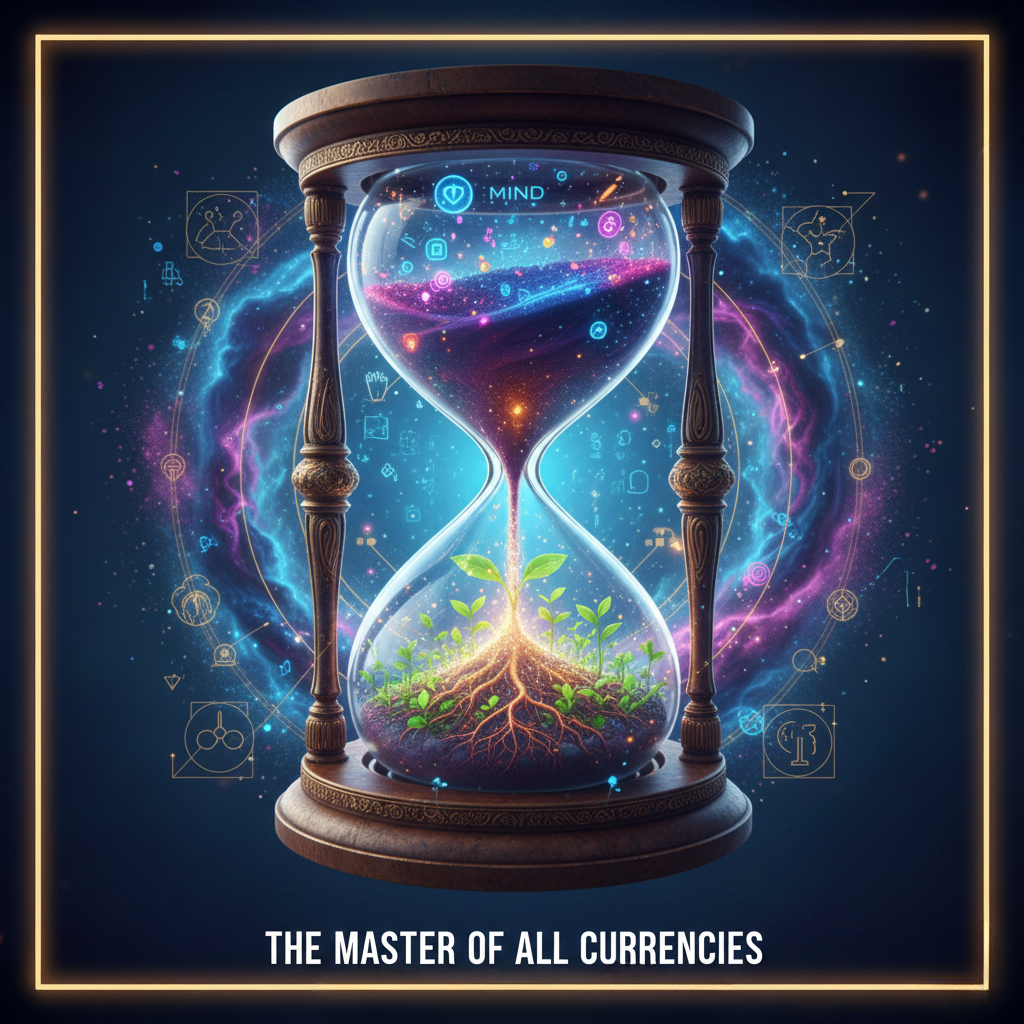
In our previous discussions, we’ve talked about reading as medicine, the mind as a weapon, and the body as a machine. But there is one invisible thread that connects them all: Time.
We often treat time like a relentless taskmaster. We race against the clock, our days a frantic symphony of deadlines and obligations. We act as if the hands on the clock face are our owners, dictating our lives from the first sip of coffee to the moment we hit the pillow.
But beneath this frenetic pace lies a brutal truth: Time is the only currency you cannot earn back.
The Illusion of "Saving" Time
We say "time is money" as if it were a resource we could hoard in a bank. We lament how it slips through our fingers like sand, yet we are the ones opening our hands and letting it pour out.
We squander this priceless asset on:
Digital Noise: Endless scrolling through feeds that add zero value to our character.
Mindless Entertainment: Binge-watching content that acts as a "temporary pill" for boredom.
The Illusion of Control: Believing we can "squeeze" more hours into a day, while refusing to manage the ones we already have.
Time is like a river; it flows at its own pace, indifferent to your ambitions. It cannot be tamed or conquered—it can only be navigated with wisdom.
“The two most powerful warriors are patience and time.”
Shifting the Function: Input vs. Output
In my post on resolutions, I mentioned that life is a function. If you want a different life, you must change the inputs. Time is the ultimate input.
What if we stopped seeing time as an adversary and started seeing it as a benevolent guide?
Time is the canvas upon which you paint your dreams.
Time is the energy you harness to heal wounds and mend broken hearts.
Time is the vehicle that carries you toward your true destiny.
It is not a linear progression toward an end; it is a cyclical dance of renewal. Every second is an invitation to reset the function of your life.
The Statistics of the "Clock"
To understand the urgency, we must look at the data. On average, a human life spans about 4,000 weeks.
Statistics show that the average person spends nearly 11 years of their life looking at a screen.
According to the Bureau of Labor Statistics, the average adult spends over 2.8 hours a day on television alone—that's roughly 9 years of life spent in a passive state.
For many, especially in the "digital wave" we discussed, social media consumption accounts for over 2 hours daily.
When you say you "don't have time" to read or exercise, remember these numbers. You have the currency; you are simply spending it on the wrong things.
“Time is a created thing. To say ‘I don’t have time,’ is like saying, ‘I don’t want to.”
How Will You Answer the Call?
The clock continues to tick. Each second is a silent question. It asks: Will you use this moment to live fully and love deeply? Or will you let it burn away in the fire of distraction?
Don't just watch the clock; do what it does. Keep moving. Use your time to leave a legacy that will echo long after the ticking stops.
Let's Discuss
If you were given an extra two hours every day that couldn't be spent on a screen, what would you do?
What is one "trivial pursuit" you are willing to cut out of your life this week?
Do you see time as your friend or your enemy? Why?
